
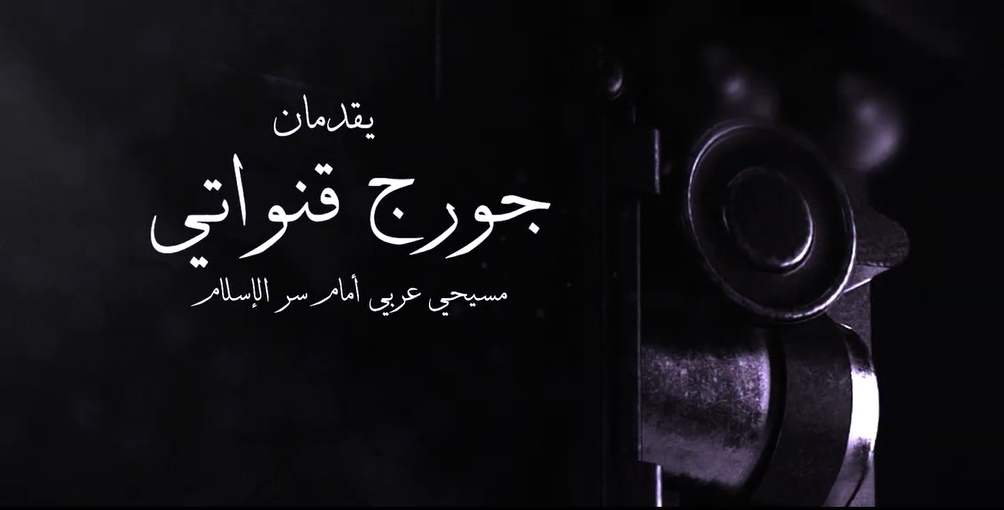
There are those who do not choose between friendship and knowledge because they have understood—through a profound intuition, perhaps irreducible to any demonstration—that one without the other is but half an existence. Father Georges Anawati was certainly one of these men. The documentary recently produced by IDEO, which we are now making available to you, does not claim to exhaustively cover his journey; rather, it more modestly restores a presence. For Anawati, before being the author of a significant body of work on Avicenna, Arabic philosophy, or Islamic mysticism—and even before being that discreet expert and advisor at the Second Vatican Council—was, in fact, a man of encounters. Through this presence and his wit, he was not a man of committees or mere declarations of intent. He was the very image of dialogue as scholarly friendship. Friendship requires time and a certain acceptance of the risk of being disturbed by the “other”. Knowledge requires rigor, critical distance, and an honesty that makes no concessions to complacency. Anawati did not choose between the two; instead, he thought and lived them together, within that fruitful tension where something new becomes possible for all parties involved. This “something new” is what the documentary attempts to name through the testimonies of those who have read his work and who seek to follow in his footsteps today. Perhaps this is the lesson of Anawati: there is no great text without small gestures, and no theology of dialogue without the daily patience of friendship. The documentary we offer you presents this reality. More than that, it brings it to life.
Session on Islamic Studies
From March 9 to 13, Emmanuel Pisani, OP and Adrien Candiard, OP led a session on Islamic studies and an introduction to interreligious dialogue at the interdiocesan seminary in N’Djamena, Chad. This formation brought together fourth-year seminarians as well as key figures in interreligious dialogue from all six Chadian dioceses.
Talks and lectures
On March 6, Emmanuel Pisani, OP gave a lecture at the Resalt al-Salam International Foundation on the topic “al-salām fī al-masīḥiyya” [Peace in Christianity].
On March 17, Emmanuel Pisani, OP gave a talk on Islamic studies during the Catholic Education Study Day for the Diocese of Toulon. The event’s topic was “War and Peace in Religions”.
On March 18, Claudio Monge, OP gave a talk entitled “ Contaminazioni devozionali islamo-cristiane: monologhi a due voci” [Reciprocal Influences between Islam and Christianity in Devotion: Monologues for Two Voice]. This took place during the SACROSANCTUM conference: “The Sacred, at the Crossroads of Theology and Culture”, held in Bologna.
On March 21, Jean Jacques Pérennès, OP gave a talk in Saint-Avold on the topic “Eastern Christians in a Middle East in Crisis: Situation and Perspectives”.
On March 22, Claudio Monge, OP gave a talk on the topic “Osare l’ospitalità” [Daring Hospitality], at the Shoah Memorial in Milan, as part of the SOUL Spirituality Festival 2026.
Board members meeting
On March 14, Emmanuel Pisani, OP participated in the Board members meeting of the association “The Friends of IDEO”.
Visits
On March 7, we welcomed Ms. Angelika Schmähling, Project Manager, and Mr. Nadim K. Ammann, Director of the “Universal Church and Dialogue” Department, at the Archdiocese of Cologne.
On March 31, we welcomed Ms. Amira Elghawaby, Canada’s former Special Representative for Combating Islamophobia and Human Rights activist.
Scholars’ House
During the month of March, we had the pleasure of receiving in the Scholars’ House:
Ms. Rosalie Mahieu, PhD student in Contemporary History at the School for Advanced Studies in the Social Sciences (EHESS);
Mr. Thomas Kremer, Director of the Research Center for the Christian East (FSCO) at the Catholic University of Eichstätt-Ingolstadt.
Publications
Dennis Halft, “Zeitenwende auch in Iran? Zwischen Warten, Bangen und Hoffen”, feinschwarz.net. Theologisches Feuilleton.
Dennis Halft, “Algerien. Kirche der Märtyrer und der Versöhnung” Information Christlicher Orient 26, n° 112, p. 12-13.
Adrien Candiard, “The God of the Philosophers: The Refutation of Thābit b. Qurra’s Talkhīṣ of the Metaphysics in Ibn Taymiyya’s Darʾ taʿāruḍ al-ʿaql wa-l-naql”, dans Mehdi Berriah et Arjan Post (ed.), Ibn Taymiyya’s Thought: Corpus, Reception, and Legacy, Leuven, Leuven University Press, 2026, p. 99-132.
Dominique Avon, « Hommes de religion sunnites et études profanes sur le Coran. Controverses autour de la distinction entre versets mecquois et médinois (années 1910 – années 1970) », dans Constance Arminjon et Rainer Brunner (dir.), Herméneutiques en Islam contemporain. Théologie, exégèse et philosophie, Turnhout, Brepols, 2026, p. 173-199.
Claudio Monge, “Riconciliarsi con la violenza del testo biblico” [Se réconcilier avec la violence du texte biblique], dans Marco dal Corso, Religioni e riconciliazione, Roma, Themis, 2026, p. 17-41.