
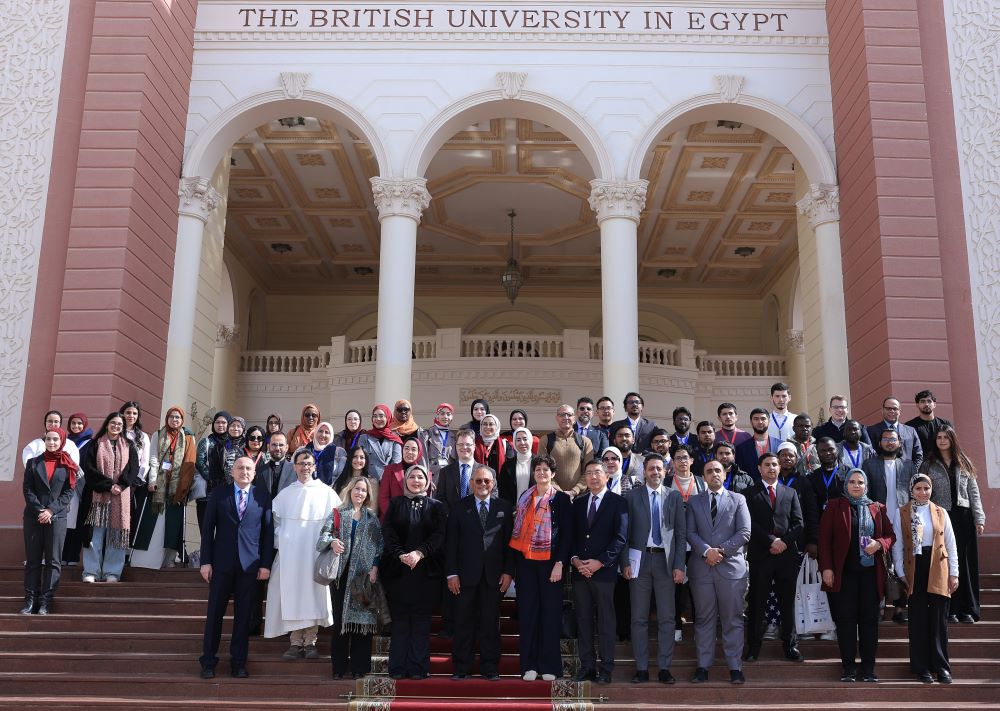
An unprecedented training week was implemented at the beginning of February on the topic “Complementarity between Religions and Human Rights.” It was organized in partnership with the Observatory for Combating Extremism and the British University in Egypt, with which we inaugurated a promising collaboration thanks to the dynamic commitment of Professor Ibrahim Salama. It is always gratifying to see that verbal commitments and framework agreements we sign with institutions take concrete form through real initiatives.
The training brought together twenty-eight students from Al-Azhar, selected by the Observatory, ten students chosen by Idéo, and four from the British University. From a human rights philosophy perspective, it was emphasized that these rights are not based solely on procedural consensus or the balancing of interests, but on a strong anthropological assertion: every human being possesses an unconditional value that precedes the state, majorities, and communal affiliations.
Thus, freedom of conscience, freedom of expression, and the delicate issue of apostasy were approached not as polemical subjects, but as arenas in which the coherence between professed faith and respect for the freedom granted by God Himself is enacted. The originality of the week lay in the cross-exposure of perspectives from contemporary Christian and Muslim theologians. Rather than adopting a purely apologetic approach, the speakers engaged with the internal tensions of their traditions, showing that fidelity to heritage does not preclude interpretive effort.
The respectful confrontation of arguments opened a space for intellectual emulation: each tradition, by allowing itself to be questioned by the other, deepens its own understanding of human dignity and the demands of justice. This theme holds particular relevance today. We live in a global context where the weight of the powerful—political, economic, or media—sometimes tends to stifle the expression and rights of the weak, whether individuals or communities. Reaffirming the complementarity between religions and human rights means rejecting the idea that the law of the strongest should become the ultimate horizon of human relations.
Anawati Chair
1. Immersive Week | Complementarity between Religions and Human Rights
From February 1 to 5, 2026, the IDEO participated in organizing an immersive training week dedicated to the topic: “Complementarity between Religions and Human Rights”. This week was organized in partnership with the Center for Human Rights Research and Training at the British University in Egypt and the al-Azhar Observatory for Combating Extremism.
This program was aimed at a new generation of religious actors called upon to play a key role in conflict prevention, diversity management, and the promotion of more inclusive societies. On this occasion, we welcomed the Deputy Head of the European Union Delegation to Egypt, Ms. Anne Schouw.
Key Speakers and Sessions:
Mr. Ibrahim Salama: Connecting the Dots between International Human Rights Frameworks, National Human Rights Mechanisms, and Religious Institutions: Tensions and Complementarity.
Mr. Michael Wiener: Religions and Beliefs from a Human Rights Perspective.
Mr. Elias el-Halabi: Christianity: Bible, patristic tradition, contemporary magisterium (e.g. Vatican II, social encyclicals). Institutions and dynamics of interpretation of sacred texts.
Adrien Candiard, OP: Freedom of Expression and Hate Speech: Cross-Religious Perspectives.
Father Bassem Raï: Efforts of Modern Muslim Thinkers Developing an Islamic Perspective of Human Rights.
Father Raymond Sarkis: Justice and Equality in Christianity: A Theological Perspective.
Emmanuel Pisani, OP and Father Charbel Attallah: Discussion on the Document on Human Fraternity.
2. Cordoba Congress | Ethics and Aesthetics in Islamic Heritage
In partnership with PLURIEL and the al-Azhar French Language Teaching Center, the Anawati Chair enabled seventeen Egyptians to participate in the congress entitled “Ethics and Aesthetics in Islamic Heritage” held in Cordoba from February 10 to 14, 2026. Academics and young researchers from al-Azhar University explored the interactions between moral philosophy and artistic expression throughout the intellectual history of Islam.
As part of this congress, the researcher Mr. Amr Zakaria delivered a presentation entitled “Critical Perspectives on Ibn Ḥazm’s Ṭawq al-Ḥamāma in Arabic Literary Critical Discourse”.
3. Seminar of The French Teaching Center of al-Azhar
On February 17, we welcomed Professor Simon Conrad for a seminar at the French Teaching Center of al-Azhar. He presented the results of his doctoral research, defended at Princeton University in June 2025 and entitled “What is Knowledge (maʿrifa)? Debates between Egyptian Philosophers and Sufis in the 30s and 40s”.
His research examines the intellectual debates between Egyptian philosophers and Sufi thinkers during the 1930s and 1940s. The presentation also addressed the role of mysticism in structuring these philosophical discussions.
Papers and presentations
During the PLURIEL Platform Congress, held in Cordoba from February 11 to 14, 2026, Emmanuel Pisani, OP presented two papers:
The first, entitled “Ethics and Aesthetics in Islamic Heritage: Towards a Research Problematic”.
The second, entitled “Ethics and Aesthetics in the Art Galleries of Zamalek: Contemporary Perspectives and Reinterpretations of Islam and the Muslim Faith”.
During the same congress, Mr. Aziz Hilal presented a paper on “The Foundations of Beauty in al-Fārābī”.
Call for Applications | IFI-IDEO 2026 Summer School in Islamic Studies
IDEO, with the support of the IFI, is organizing a summer school for doctoral students on the topic “Islamic Sciences in Dialogue: Azhari Tradition and Critical Islamic Studies”, from July 13 to 26, 2026 (classes begin on July 14). Application Deadline: April 1, 2026.
Information and applications: Call for Applications | IFI–IDEO 2026 Summer School in Islamic Studies (in French)…
Scholars’ House
During the month of February, we had the pleasure of welcoming to the Scholars’ House:
Mr. Andreas Nabil Younan, a PhD student and Gates Cambridge Scholar at the Faculty of Asian and Middle Eastern Studies, University of Cambridge. Andreas is a legal historian who, in his dissertation, studies parliamentary life in Egypt during the 1970s and 1980s;
Ms. Tessa Larivière-Ammari, a PhD student in the history of the medieval Muslim world at Aix-Marseille University. She is working on the political and intellectual history of the Nizari Ismailis of Northern Syria during the Mamluk period (1260–1516), under the supervision of Mr. Julien Loiseau;
Ms. Sarah Yona Zweig, Assistant Professor of World Classical Literature at Ashoka University (Delhi). She is currently completing her doctorate, which focuses on the literary trajectories of Alexander the Great narratives in Late Antiquity. Her ongoing research project in Cairo involves the study of Arabic manuscripts of the Alexander Romance.
Recensions
Emmanuel Pisani, « Gabriel Martinez-Gros, Ibn Khaldûn, Anthologie », Archives de sciences sociales des religions 212, 2025, p. 292-293.
Emmanuel Pisani, « Yann Vagneux, Une émulation de sainteté. Hindouisme et christianisme en dialogue », Archives de sciences sociales des religions 212, 2025, p. 323-324.
Emmanuel Pisani, « Anne-Sophie Lamine, Au-delà du séparatisme et de la radicalisation. Penser l’intensité religieuse musulmane en France », Archives de sciences sociales des religions, 212, 2025, p. 286-288.
Publications
Dominique Avon, « Jacques Ellul et l’islam. Analyse d’un discours et de sa réception », dans Mohammad Ali Amir-Moezzi, Pierre-Olivier Léchot, Anna Van den Kerchove (dir.), Protestantisme et islam. Regards croisés (XVIᵉ-XXIᵉ siècles), Turnhout, Brepols, 2026, p. 227-246.
Dennis Halft, “Zu Besuch bei den 19 Märtyrer*innen in Algerien – ein theologischer Ortswechsel [Visiting the 19 Martyrs in Algeria – A Theological Change of Location]”, feinschwarz.net, February 6, 2026 (online publication).
On February 25, 2026, the German Bishops’ Conference (DBK) published the official document entitled “Christlich-muslimische Beziehungen in Deutschland” [Christian-Muslim Relations in Germany], to which Dennis Halft, OP, a Consultant to the DBK for Interreligious Dialogue, contributed. The document is available for free download.
Upcoming activities
Franco-German Conference at the Karlsruhe University of Education
From March 19 to 21, 2026, the Karlsruhe University of Education in Germany will organize a Franco-German conference entitled “A Theology for a New Age? Transcultural and Interreligious Perspectives between France and Germany in Dialogue with Claude Geffré (1926-2017)”.
This event is organized by Dennis Halft (Trier), in collaboration with Tobias Specker, S.J. (Frankfurt am Main) and Professor Michael Quisinsky (Karlsruhe). See the program…
“Priests and Sufis” Conference
On June 6 and 7, 2026, IDEO, in partnership with the Catholic University of the Sacred Heart of Milan, is organizing a conference in Cairo entitled “Priests and Sufis: Rethinking Catholic Knowledge of Islamic Mysticism”.