
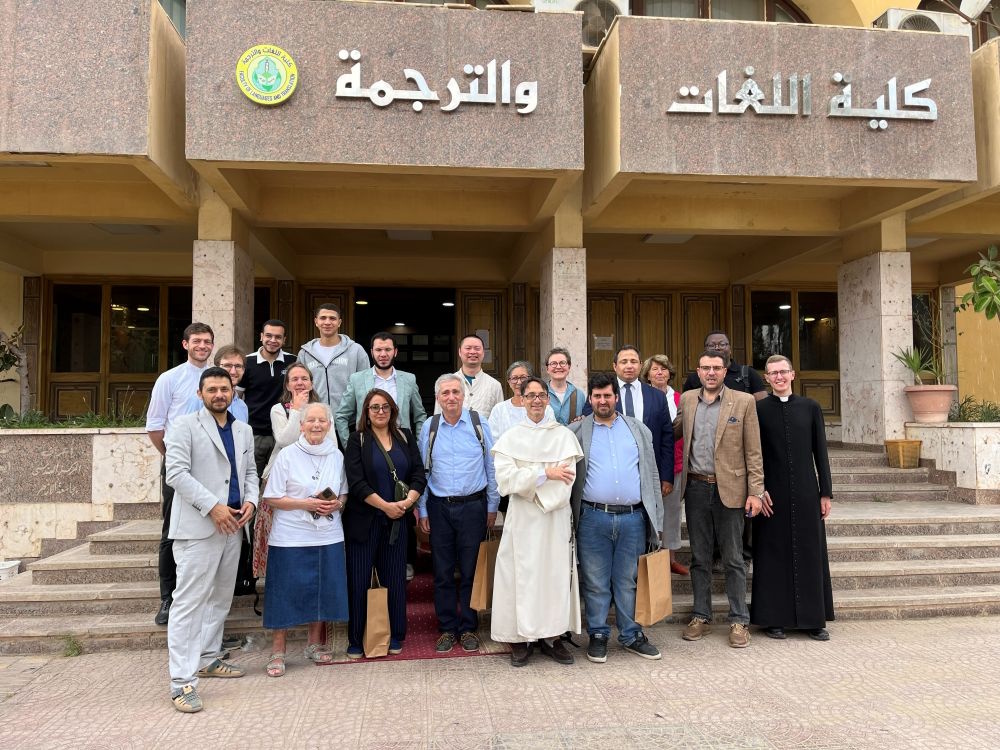
The visit of ISTR students from Paris provided a valuable opportunity to meet with al-Azhar’s Department of Islamic Studies, headed by Dr. Ali Abdelhakim. It also allowed for a discussion on the Document on Human Fraternity with students from the CEF of al-Azhar, directed by Dr. Mona Sabry. These encounters gave concrete expression to a partnership and made it possible to assess how each side understands dialogue and the kinds of questions they raise. At al-Azhar, for example, a speaker from Paris was asked whether, from his perspective, there exists a Islamic truth and a Christian truth, while another participant asked why European Christian heads of state have declared so many wars if Christianity is a religion of peace. These questions highlight both the urgent necessity and the relevance of such encounters. They reveal more than a simple cultural gap; they raise the question of the possibility of an interreligious dialogue that is neither relativistic nor exclusivist, but genuinely theological. They call for addressing the issue of the unity of truth in the face of the diversity of historical traditions, as well as the possibility of a plurality of religious mediations. From this perspective, dialogue becomes a hermeneutical space in which truth itself is discovered more deeply. The second question introduces an ethical and historical dimension. While it reminds us that religious truth cannot be separated from its historical effects, it also invites, from a theological standpoint, a distinction between the normative content of a faith and the distortions introduced by its adherents. Here again, it is clear that no tradition can claim the truth without acknowledging its own historical ambiguities. Interreligious dialogue often begins where the most challenging questions arise. It is also there that dialogue becomes a theological act in practice: not a compromise, not diplomacy, but a mutual testing of truth claims, oriented toward a broader understanding of the divine mystery.
Anawati Chair
The “Women and Religions” Certificate was launched with the participation of Ms. Omaima Abou-Bakr, Professor of Comparative English Literature at Cairo University and founding member of the Women and Memory Forum. Her seminar was entitled “Women’s Rights and Legal Provisions within the Islamic and Qurʾānic Framework”. Forty students were selected to take part.
Training Sessions
From April 20 to 23, Emmanuel Pisani, OP taught a 24-hour course in Toulouse at the Institute of Religious and Pastoral Studies (IERP). The topic was “Jesus in Religious Traditions”.
During the month of April , Adrien Candiard, OP taught at two universities in Rome:
At the University of Saint Thomas Aquinas (Angelicum), he taught a 24-hour class called “Speaking about God in Islam: An Introduction to Islamic Theology”, designed for students pursuing a canonical licentiate in theology.
At the Pontifical Institute for Arabic and Islamic Studies (PISAI), he taught an 18-hour course titled “Lettura di testi di teologia islamica – La questione degli atti umani” [Reading Islamic Theological Texts – The Question of Human Acts], for the Institute’s third-year students.
Communication
On April 16, Emmanuel Pisani, OP gave an online presentation on “Christians in Egypt”, as part of a study day organized by the French Catholic association Œuvre d’Orient.
Radio Broadcast
On March 25, Mr. Dominique Avon participated in the France Culture program “War in the Middle East: History as a Guide”, in the episode titled “Hezbollah: History of an Armed Organization”. Listen to the program [in French]…
Framework Agreement
We are happy to announce that IDEO signed a framework agreement with the Al Mowafaqa Ecumenical Institute of Theology in Rabat on April 15, 2026.
Visits
On April 1, we welcomed Mr. Raymond Chow, Minister-Counsellor of the Singapore Embassy in Cairo.
On April 26, as part of a study trip to Egypt by the Institute of Science and Theology of Religions (ISTR) in Paris, IDEO welcomed its director, Father Xavier Gué, along with thirteen students. Emmanuel Pisani, OP, Jean Druel, OP and Mateus Domingues da Silva, OP gave presentations.
On April 28, we welcomed a group of students from the Faculty of Theology and Religious Sciences at Lund University.
Scholars’ House
During the month of April, we were delighted to welcome to the Scholars’ House:
Ms. Rocio Daga, Professor of Religious Studies at Ludwig-Maximilian University of Munich;
Mr. Onsi Kamel, PhD student in Philosophy and Religion at Princeton University;
Mr. Nils Fischer, Director of the Near East Unit for the Catholic Academic Exchange Service (KAAD).
Publications
Guillaume de Vaulx, “French Kiss, Arabic Culture. Ahmad b. al-Tayyib al-Sarakhsī on Love in Light of Rasāʾil Iḫwān al-ṣafā”, Fondazione per le Scienze Religiose 3, 2025, p. 37-84.
Michel Cuypers, « Un guide avancé pour l’analyse rhétorique du Coran. L’énigmatique sourate 67, al-Mulk, La Royauté », Academia.edu.
Emmanuel Pisani, « Chaire en contexte. Fight against Religious Extremism by Promoting Interfaith Dialogue, l’exemple de la Chaire Anawati de l’Idéo (2023-2027) » ET-Studies, 17/1, 2026, p. 155-165.